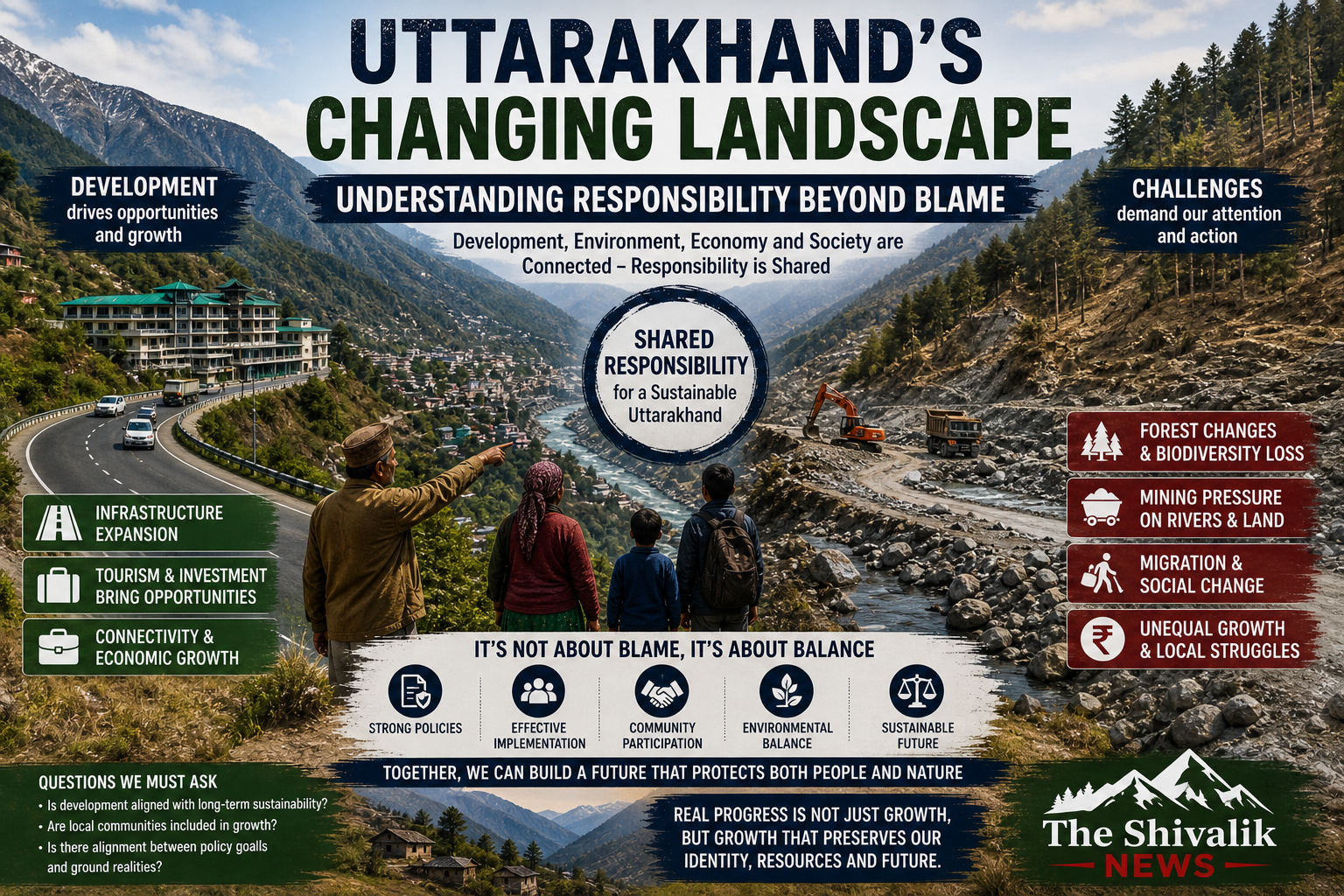
Uttarakhand Changing Landscape 2026: 10 Big Environmental Challenges
Introduction
Uttarakhand changing landscape has become one of the most important discussions in recent years as the state experiences rapid environmental, economic, and social transformation.
Over the past 15 years, Uttarakhand has witnessed visible and invisible changes. Forest structures are shifting, rivers are under pressure, migration is increasing, and land use patterns continue to evolve.
When viewed individually, each issue tells a separate story. But when connected together, they reveal a much larger picture — one where development, environment, economy, and society are deeply interconnected.
This report does not aim to blame any one group or institution. Instead, it attempts to understand how responsibility is shared across systems, policies, markets, and society itself.
Because in complex situations, the real question is often not “Who is responsible?” but “How is responsibility shared?”
Table of Contents
- Uttarakhand changing landscape and the bigger picture
- Uttarakhand changing landscape and governance challenges
- Uttarakhand changing landscape and environmental pressure
- Economic forces behind Uttarakhand changing landscape
- Uttarakhand changing landscape and migration
- How the Uttarakhand changing landscape is interconnected
- The gap between planning and reality
- Sustainable development challenges in Uttarakhand
- Important questions about Uttarakhand changing landscape
- Conclusion
Uttarakhand changing landscape and the bigger picture
The environmental and social issues visible in Uttarakhand today are not isolated problems.
This includes:
- Land use changes
- Mining pressure on rivers
- Forest fragmentation
- Migration from hill villages
- Uneven economic development
Each of these developments influences the others.
Economic growth creates demand for land and resources. Resource use impacts the environment. Environmental changes affect livelihoods, which then influence migration and local economies.
This interconnected structure forms the foundation of the Uttarakhand changing landscape.
Uttarakhand changing landscape and governance challenges
Policies and regulations play a major role in managing development in Uttarakhand.
Frameworks already exist for:
- Environmental protection
- Mining regulation
- Forest conservation
- Rural development
- Land management
However, implementation often becomes the biggest challenge.
Common issues include:
- Limited ground-level monitoring
- Regional enforcement gaps
- Balancing development with sustainability
These governance challenges become more visible in ecologically sensitive hill states like Uttarakhand.
The Uttarakhand changing landscape highlights why stronger policy implementation is becoming increasingly important.
Uttarakhand changing landscape and environmental pressure
Development is necessary for economic growth and connectivity.
Roads, tourism projects, hydropower, and infrastructure expansion bring opportunities to remote regions.
But rapid development also creates pressure on:
- Land resources
- Rivers and water systems
- Forest ecosystems
- Local communities
The challenge is not whether development should happen — but how development can remain balanced and sustainable.
Experts believe the Uttarakhand changing landscape is directly linked with rising environmental pressure and changing land use patterns.
Economic forces behind Uttarakhand changing landscape
Economic and market forces strongly influence Uttarakhand’s development patterns.
Examples include:
- Land becoming a high-value investment asset
- Growing demand for natural resources
- Tourism-driven construction growth
- Expansion of commercial infrastructure
These trends are part of larger economic systems.
However, in fragile ecosystems like Uttarakhand, their environmental impact becomes much more significant.
The Uttarakhand changing landscape reflects how economic growth and environmental sustainability are now deeply connected.
Uttarakhand changing landscape and migration
Social changes are equally important in understanding the Uttarakhand changing landscape.
Several trends are reshaping local communities:
- Young people migrating to cities
- Declining dependence on agriculture
- Changing lifestyles and aspirations
- Increasing urbanisation
Migration in Uttarakhand continues to affect both rural economies and local social structures.
Many villages are experiencing population decline as younger generations move toward urban areas in search of employment and better opportunities.
How the Uttarakhand changing landscape is interconnected
One of the most important realities is that all these issues are connected.
For example:
- Land use change influences migration
- Migration affects local economies
- Economic shifts influence resource use
- Resource use impacts environmental balance
This shows that Uttarakhand’s current situation is not driven by a single issue or a single decision.
It is the result of multiple interconnected systems evolving together over time.
Understanding the Uttarakhand changing landscape requires looking at development, economy, governance, and environment together instead of separately.
The gap between planning and reality
Many development projects and policies are designed with positive intentions.
However, outcomes on the ground may differ because of:
- Execution challenges
- Local geographical conditions
- Monitoring limitations
- Unintended consequences
This gap between planning and reality often shapes many environmental and social challenges visible today.
In many cases, the effects of the Uttarakhand changing landscape become visible slowly over time rather than immediately.
Sustainable development challenges in Uttarakhand
For Uttarakhand, the future challenge is achieving sustainable development while protecting ecological balance.
Several areas may require greater focus:
- Stronger implementation systems
- Transparent development processes
- Local community participation
- Environmentally responsible planning
Sustainable development in Uttarakhand cannot rely on short-term growth alone.
Long-term ecological stability must also remain a priority.
The future of the Uttarakhand changing landscape will depend on how effectively development and environmental protection can move together.
Important questions about Uttarakhand changing landscape
Several critical questions deserve attention:
- Is development aligned with long-term sustainability?
- Are local communities included in growth processes?
- Can economic progress coexist with environmental protection?
- How can Uttarakhand balance tourism, development, and ecology?
These questions are becoming increasingly important as the Uttarakhand changing landscape continues to evolve.
External Resources
👉 Government of Uttarakhand
https://uk.gov.in/
👉 Ministry of Environment, Forest and Climate Change
https://moef.gov.in/
👉 NITI Aayog Reports
https://www.niti.gov.in/
Related Articles
👉 Uttarakhand Forest Cover Changes
https://theshivalik.com/uttarakhand-forest-cover-changes/
👉 Uttarakhand River Mining Impact
https://theshivalik.com/uttarakhand-river-mining-impact/
👉 Uttarakhand Development Reality
https://theshivalik.com/uttarakhand-development-reality-2026/
People Also Ask
Who is responsible for Uttarakhand’s current environmental challenges?
Responsibility is shared across governance systems, development models, market forces, and social changes.
Is development affecting the environment in Uttarakhand?
Rapid development can increase pressure on forests, rivers, and fragile ecosystems if not managed sustainably.
What role do policies play in Uttarakhand development?
Policies guide land use, mining, conservation, and infrastructure development, but implementation remains crucial.
How can sustainable development be achieved in hill states?
Through balanced planning, environmental protection, transparency, and community participation.
Conclusion
Uttarakhand’s current situation is not the result of one decision or one institution alone.
It is the outcome of multiple forces interacting over time:
- Development
- Economy
- Governance
- Society
- Environment
Understanding this shared responsibility is the first step toward meaningful long-term planning.
The next challenge is ensuring that future development in Uttarakhand remains:
- Sustainable
- Inclusive
- Environmentally balanced
Because true progress is not measured only by economic growth — but by how well that growth protects the identity, stability, and future of the region.
The future of the Uttarakhand changing landscape will depend on balanced planning, responsible development, and long-term environmental sustainability.
Join the Conversation
Do you think Uttarakhand’s development model is sustainable for the future?
Share your thoughts in the comments
Share this article to spread awareness
Follow The Shivalik News for more ground reports and environmental updates