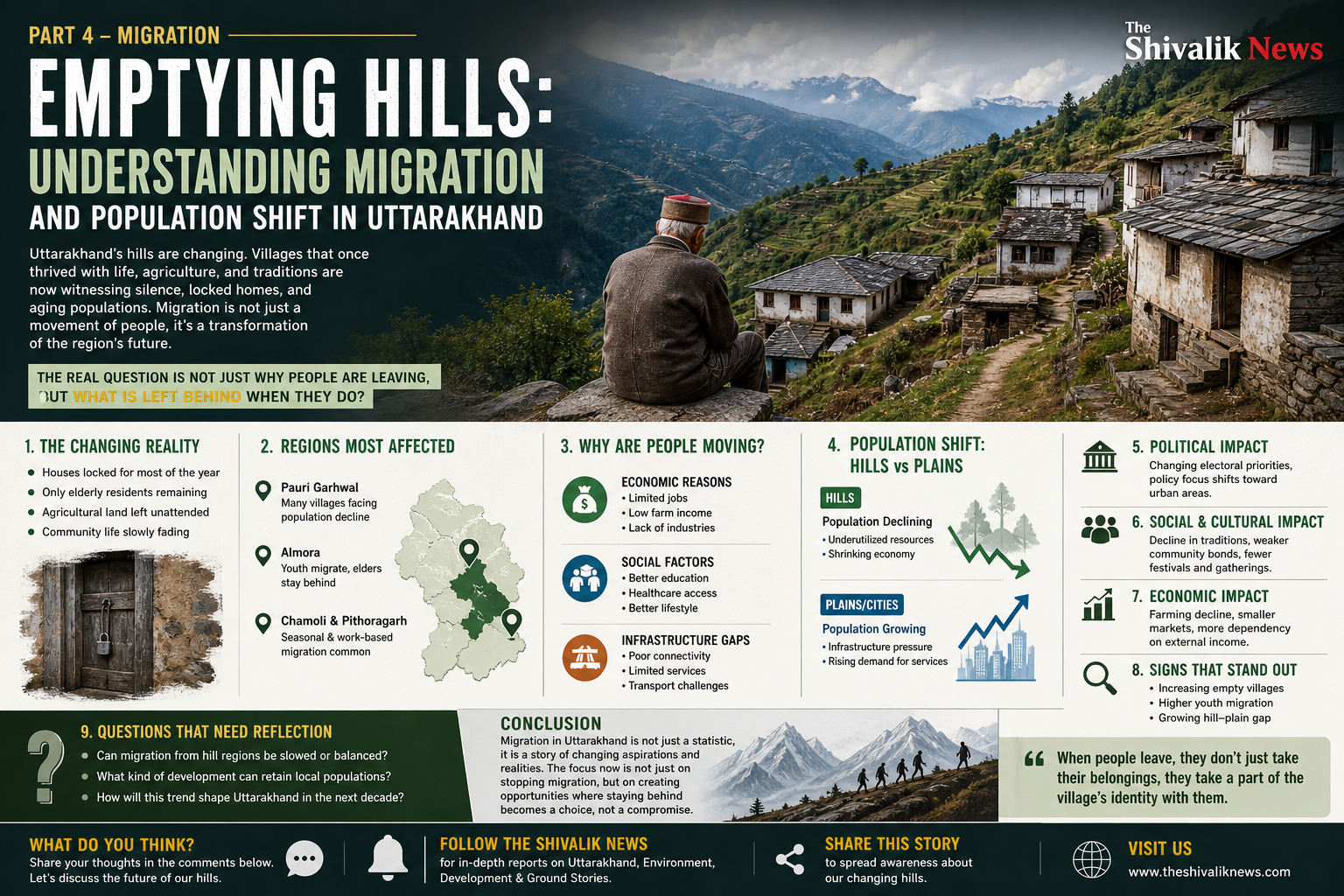
9 Key Facts About Uttarakhand Migration and Empty Hill Villages | The Shivalik News
Introduction
Uttarakhand Migration has become one of the most discussed social and demographic challenges in the Himalayan state. Across several hill districts, villages that once had active community life, farming, and cultural traditions are now witnessing locked homes, shrinking populations, and abandoned agricultural land.
Over the last 15 years, migration from Uttarakhand’s hill regions has steadily increased, reshaping the state’s economy, population distribution, and rural identity.
Across the hill regions of Uttarakhand, a silent transformation is unfolding. Villages that once echoed with farming activity, festivals, and community gatherings are now witnessing locked homes, empty fields, and shrinking populations. Over the last 15 years, migration from Uttarakhand’s hill districts has steadily increased, creating a growing contrast between the hills and the plains.
This population shift is not just changing demographics — it is reshaping Uttarakhand’s economy, culture, governance, and rural identity. Because the real question is no longer just why people are leaving, but what remains behind when they do.
Also Read: River Mining Impact in Uttarakhand
1. Uttarakhand Migration and the Changing Reality of Villages
In many hill districts, the structure of village life is changing rapidly.
Common observations include:
- Houses locked for most of the year
- Elderly residents living alone
- Declining agricultural activity
- Reduced community participation
- Empty or partially inhabited villages
The growing Uttarakhand Migration trend is affecting village life and local communities.
The term “Ghost Villages in Uttarakhand” has increasingly become part of public discussion. While not always an official category, it reflects the visible demographic decline occurring across several regions.
In many cases, villages are not fully abandoned — they are slowly losing population year after year.
2. Regions Most Affected by Migration
Pauri Garhwal
Often highlighted in discussions around rural migration and population decline in Uttarakhand.
Almora
A growing ageing population is visible as younger generations migrate toward cities for education and employment.
Chamoli & Pithoragarh
Several areas also witness seasonal migration linked to temporary work opportunities.
The intensity may vary across districts, but the broader migration trend across Uttarakhand’s hill regions remains significant.
3. Why Is Uttarakhand Migration Increasing?
Migration from hill areas is driven by multiple interconnected factors.
Economic Reasons
- Limited employment opportunities
- Declining returns from farming
- Lack of local industries
Social Reasons
- Better education opportunities in cities
- Improved healthcare facilities
- Aspirations for better lifestyles
Infrastructure Challenges
- Poor road connectivity
- Limited access to services
- Transportation difficulties
For many families, migration gradually becomes a practical necessity rather than a temporary decision.
Experts believe Uttarakhand Migration could significantly reshape population distribution in the coming decade.
4. Uttarakhand Migration and Population Shift: Hills vs Plains
While hill populations decline, urban and plains regions continue to grow rapidly.
Source: Census of India
Observed Trends:
- Population growth in Dehradun and Haridwar
- Increased urban housing demand
- Pressure on infrastructure and public services
This creates a dual imbalance:
In Hill Regions:
- Underutilized land and resources
- Shrinking rural economy
In Plains & Urban Areas:
- Overcrowding
- Infrastructure stress
- Environmental pressure
Many empty villages are now seen as symbols of the wider Uttarakhand Migration crisis.
5. Political and Governance Impact
Demographic changes directly influence governance and policy priorities.
Reference: NITI Aayog Reports
Migration can affect:
- Electoral representation
- Rural development focus
- Policy allocation
- Administrative priorities
As populations shift toward urban centers, rural concerns may receive comparatively less attention.
6. Social and Cultural Impact of Uttarakhand Migration
Migration impacts more than numbers — it changes the social fabric of Uttarakhand.
Key Effects:
- Decline in traditional customs
- Weakening of village networks
- Reduced inter-generational interaction
- Fewer local festivals and gatherings
Many villages are witnessing gradual cultural transformation alongside population decline.
7. Economic Impact of Uttarakhand Migration
A declining population also weakens the local economy.
Economic Effects Include:
- Reduced farming activity
- Shrinking local markets
- Dependency on external income sources
This creates a recurring cycle:
Less Population → Less Economic Activity → More Migration
The Uttarakhand Migration trend is impacting rural communities and local economic stability.
Related Report: Climate Change in Uttarakhand
8. Major Signs of the Growing Migration Trend
Several indicators highlight the ongoing demographic shift in Uttarakhand:
- Rising number of empty villages
- Increasing migration among youth
- Growing imbalance between hills and plains
- Declining participation in local agriculture
- Reduced rural economic activity
9. Important Questions for Uttarakhand’s Future
- Can migration from hill regions be balanced?
- What type of development can encourage people to stay?
- How can employment opportunities grow in rural Uttarakhand?
- What will Uttarakhand’s villages look like in the next decade?
Frequently Asked Questions
Why are villages becoming empty in Uttarakhand?
Limited employment, weak infrastructure, education challenges, healthcare access, and declining agricultural income are major reasons behind migration from Uttarakhand’s hill villages.
What are ghost villages in Uttarakhand?
Ghost villages are villages that have become partially or completely uninhabited due to migration and population decline.
Why is migration increasing in hill areas?
Economic pressures, social aspirations, and limited opportunities in rural areas contribute to rising migration.
How does migration affect Uttarakhand’s economy?
Migration reduces agricultural activity, weakens local businesses, and increases dependence on urban income sources.
Conclusion
Migration in Uttarakhand is not just a statistic — it is a quiet transformation shaping the future of the hills.
It reflects aspirations, challenges, changing lifestyles, and evolving economic realities.
The challenge today is not only to reduce migration, but to create opportunities where staying in the hills becomes sustainable, practical, and hopeful.
Because when people leave, they do not just leave homes behind — they take a part of the village’s identity with them.
Experts are increasingly concerned about the long-term impact of Uttarakhand Migration on Himalayan communities.
CTA
What do you think is the biggest reason behind migration from Uttarakhand’s hills?
Share your opinion in the comments below and join the conversation.
Follow The Shivalik News for in-depth reports, Uttarakhand ground stories, environmental coverage, and regional analysis shaping the future of the Himalayas.
Don’t forget to share this article to spread awareness about the changing reality of Uttarakhand’s villages.