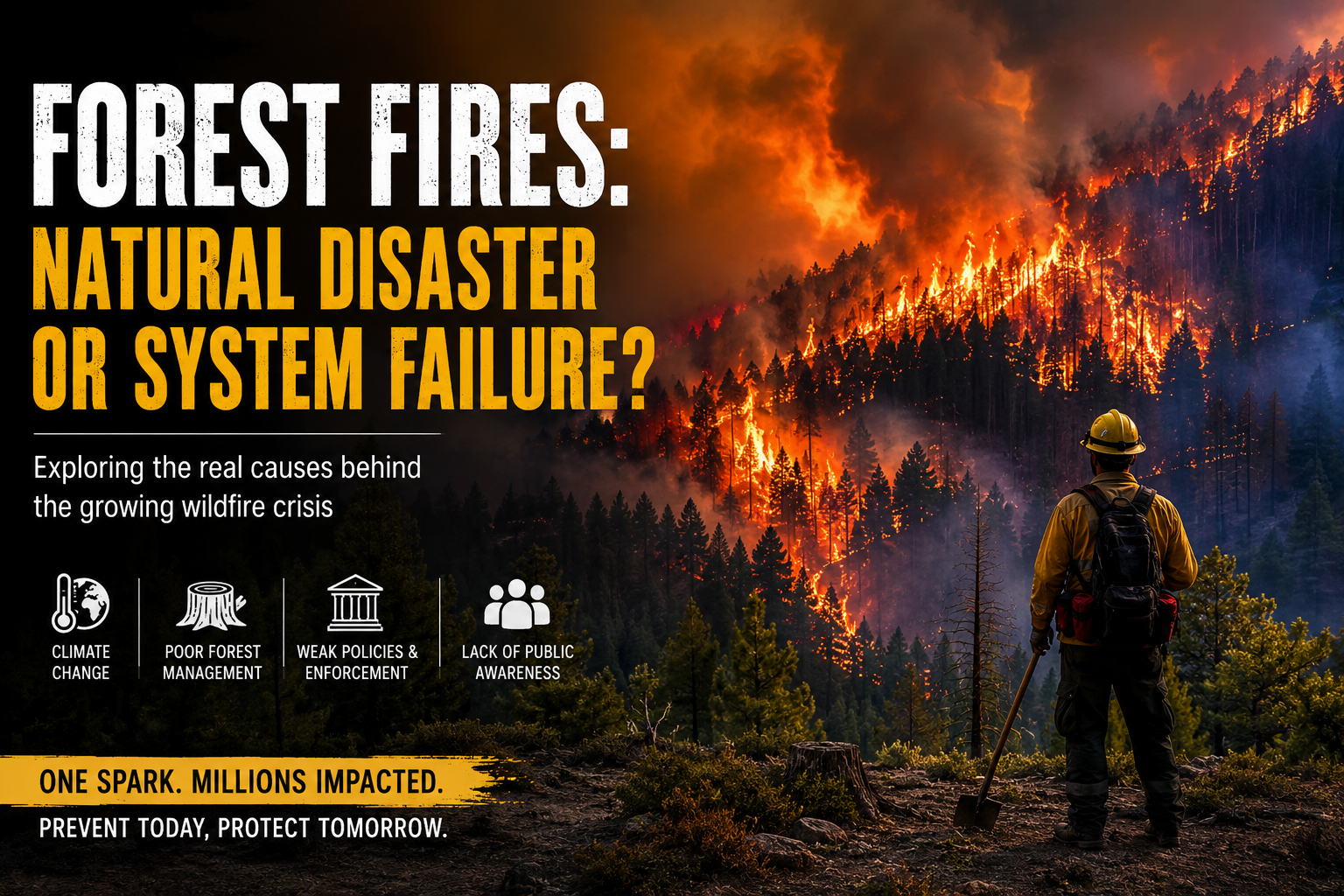
Forest Fires: When Nature Burns and Systems Fail
Forests don’t burn overnight—years of neglect, climate change, and policy failures turn a single spark into a catastrophe.
Every summer, images of towering flames consuming vast stretches of forests dominate headlines across the world. From the dense woodlands of North America and Europe to the fragile Himalayan ecosystems of India, forest fires are becoming larger, deadlier, and more frequent than ever before.
For decades, wildfires were largely viewed as natural disasters—unpredictable events triggered by lightning strikes, extreme heat, or natural environmental cycles. However, the growing intensity and frequency of modern forest fires have forced scientists, policymakers, and environmentalists to rethink this narrative.
A crucial question now emerges: Are forest fires purely natural disasters, or are they symptoms of deeper human and systemic failures?
The answer may determine how governments, communities, and environmental agencies respond to one of the most pressing ecological challenges of the 21st century.
Understanding Forest Fires
Forest fires, commonly known as wildfires, are uncontrolled fires that spread rapidly through forests, grasslands, and other natural landscapes. Under favorable conditions—such as dry vegetation, high temperatures, and strong winds—a small ignition source can quickly evolve into a large-scale disaster.
Traditionally, natural causes such as lightning strikes were responsible for many forest fires. Today, however, human activity has become one of the leading contributors to wildfire outbreaks worldwide.
Common human-related causes include:
- Carelessly discarded cigarette butts
- Unattended campfires
- Agricultural burning
- Electrical infrastructure failures
- Land clearing activities
- Deliberate acts of arson
As forests become drier due to changing climate patterns, even minor human negligence can have devastating consequences.
Climate Change: Fueling a Global Wildfire Crisis
Climate change has fundamentally altered the conditions under which forest fires occur.
Rising global temperatures have increased the frequency of heatwaves and prolonged drought periods, creating ideal environments for wildfires. Forests that once retained moisture throughout the year are now becoming increasingly vulnerable during warmer months.
According to the United Nations Environment Programme (UNEP), rising temperatures and prolonged droughts are increasing wildfire risks across the globe.
Scientists have observed several alarming trends:
Longer Fire Seasons
Wildfire seasons are starting earlier and ending later than in previous decades, leaving forests exposed to fire risks for extended periods.
More Intense Heatwaves
Extreme temperatures dry out vegetation faster, transforming forests into highly combustible landscapes.
Reduced Rainfall and Soil Moisture
Many regions are experiencing prolonged dry spells, making it easier for fires to ignite and spread.
Stronger Winds
Changing weather patterns often generate stronger winds that accelerate wildfire movement and make containment efforts more difficult.
Climate change may not ignite every fire, but it significantly increases the likelihood that a small fire will become a major disaster.
When a Natural Hazard Becomes a System Failure
While nature may provide the spark, the scale of destruction often reveals deeper governance and management failures.
Poor Forest Management
Many forest regions suffer from inadequate maintenance and monitoring. Dead trees, dry leaves, and unmanaged vegetation accumulate over time, creating enormous fuel reserves.
Without proper forest management practices such as controlled burns and vegetation clearing, forests become increasingly susceptible to large-scale fires.
Inadequate Fire Prevention Infrastructure
Modern technologies, including satellite monitoring, drones, and automated fire detection systems, have improved wildfire management in several countries.
However, many regions still rely on outdated systems, resulting in delayed detection and slower emergency responses.
Weak Policy Enforcement
Illegal encroachments, unauthorized burning, and unregulated development near forest zones continue to increase wildfire risks.
Environmental regulations often exist on paper but remain poorly enforced due to limited resources or administrative challenges.
Lack of Community Awareness
Local communities are often the first line of defense against forest fires. Yet many residents living near forest areas lack adequate training and awareness regarding fire prevention and emergency response measures.
India’s Growing Forest Fire Challenge
India witnesses thousands of forest fire incidents every year, particularly during the dry summer months.
States such as Uttarakhand, Himachal Pradesh, Madhya Pradesh, Odisha, Chhattisgarh, and Maharashtra frequently experience wildfire outbreaks.
The Himalayan region presents unique challenges:
- Steep and inaccessible terrain
- Dry pine needle accumulation
- Increasing tourism activities
- Expanding human settlements near forest zones
- Limited firefighting infrastructure
In Uttarakhand alone, recurring forest fires have raised concerns among environmental experts regarding biodiversity loss, declining water resources, and ecological degradation.
As temperatures continue to rise, India’s forests face mounting pressure from both natural and human-induced threats.
Environmental Consequences of Forest Fires
The damage caused by forest fires extends far beyond the visible destruction of trees.
Loss of Biodiversity
Forests provide habitat for countless species of plants, birds, mammals, reptiles, and insects.
When wildfires occur, entire ecosystems can be disrupted, threatening endangered species and reducing biodiversity.
Increased Carbon Emissions
Forests act as natural carbon sinks, absorbing carbon dioxide from the atmosphere.
When forests burn, stored carbon is released back into the atmosphere, accelerating global warming and contributing to climate change.
Soil Degradation
Intense fires damage soil structure and destroy essential nutrients.
This reduces fertility, increases erosion, and makes ecosystem recovery more difficult.
Water Resource Impacts
Burned landscapes often experience increased runoff and sedimentation, affecting rivers, lakes, and reservoirs.
Water quality can deteriorate significantly, impacting both wildlife and human populations.
The Economic and Social Cost
Wildfires are not only environmental disasters; they also create significant economic and social challenges.
Communities affected by forest fires often experience:
- Destruction of homes and infrastructure
- Loss of agricultural productivity
- Tourism revenue declines
- Increased healthcare costs from smoke exposure
- Displacement of local populations
Governments are frequently forced to spend millions on emergency response, rehabilitation, and recovery efforts.
The long-term economic burden often exceeds the immediate cost of firefighting operations.
Prevention: The Most Effective Solution
Experts consistently emphasize that preventing forest fires is far more effective than responding to them after they occur.
Several strategies can significantly reduce wildfire risks:
Advanced Monitoring Systems
Satellite surveillance and drone technology can help detect fires at an early stage.
Community Participation
Local residents should be actively involved in fire prevention and awareness programs.
Controlled Burning
Carefully managed burns can reduce excessive vegetation and lower fuel loads.
Stronger Environmental Policies
Governments must enforce regulations against illegal activities that increase wildfire risks.
Climate Action
Reducing greenhouse gas emissions remains critical to limiting the long-term drivers of extreme wildfire conditions.
Shared Responsibility for a Shared Future
Forest fires are often portrayed as unavoidable acts of nature. Yet a closer examination reveals that many of today’s most destructive wildfires are amplified by human actions, policy shortcomings, and inadequate preparedness.
Climate change, poor forest management, weak enforcement mechanisms, and insufficient investment in prevention have transformed what were once isolated natural events into recurring environmental crises.
Protecting forests requires more than emergency firefighting efforts. It demands long-term planning, scientific management, public awareness, and political commitment.
The future of our forests—and the communities that depend on them—will depend on whether we address the root causes of these disasters before the next spark ignites another catastrophe.
Conclusion
Forest fires may begin with a lightning strike, a discarded cigarette, or a moment of negligence. But the scale of destruction that follows is often shaped by choices made long before the flames appear.
As the world faces rising temperatures and increasingly unpredictable weather patterns, forest fires can no longer be viewed solely as natural disasters. They are also indicators of how effectively societies manage their natural resources and prepare for environmental challenges.
The real question is not whether another forest fire will occur.
The real question is whether we have learned enough to prevent the next one.
The real question is whether we have learned enough to prevent the next one.”
Read more environmental reports and climate-related coverage on The Shivalik News.
What Do You Think?
Are forest fires unavoidable natural disasters, or are they evidence of failures in climate action, forest management, and governance?
Share your thoughts in the comments and join the conversation on protecting our forests for future generations.